Brody Walls adds a new dimension to Texas Baseball's bullpen
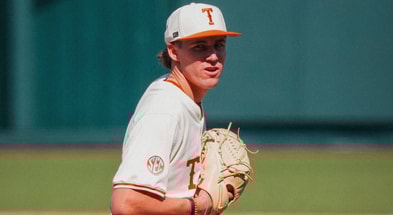
Yesterday, Texas true freshman Brody Walls was arguably Texas’ best player for the first 7.5 innings of their midweek win over UTSA.
Walls threw 3 2/3 innings of 1 H, 1 ER baseball, striking out a career-high five and walking just one. It was his most impressive appearance of the year, which featured multiple multi-inning SEC relief stints in games Texas was losing.
That’s mostly been his role this year: Tuesday stints and long relief roles while Texas is already down big. He came in for back-to-back weeks against South Carolina and Texas A&M in games the Longhorns were losing badly after poor starts from Ruger Riojas and Luke Harrison.
But Tuesday’s showing might add a new wrinkle to this Longhorn team.
Pitching that well against UTSA isn’t comparable to your standard midweek team. That’s the best program in the American, a tournament team with a top-25 OPS in the nation. They have real, live bats that Walls had to deal with. Head coach Jim Schlossnagle put it best.
“Brody was the story because swings changed when he came in the game,” Schlossnagle said. “They have a really good team, competitive, right- and left-handed hitters. They don’t swing and miss much, and they swung and missed against Brody; that tells you a lot.”
Schlossnagle couldn’t stop praising the freshman, which begs the question for Texas going forward.
How do you best utilize Walls and the rest of the bullpen?
Optimally, a team comes into the postseason 10-deep in their staff:
3 reliable starters
1 fourth/flex starter who can also work in long relief
1 closer
3 high-leverage arms
2 matchup-dependent options
Texas has arguably the best starter–closer quartet in the nation, and the leverage arms of Crossland, Leffew, and Burns are generally great options for now.
With Walls, you can find the final three spots in the staff with Max Grubbs, who might be the best option as the flex starter, alongside Walls and LHP Ethan Walker.
From talking with Schlossnagle and his staff, it’s clear that Texas makes its pitching decisions based on individual matchups.
Sometimes it’s as simple as putting in Walker to face 2–3 lefties, but it’s often much deeper than that. Is there an arm angle a specific player struggles with? Do they favor high fastballs and struggle with offspeed? Is there a trio of batters more susceptible to swing-and-miss stuff?
That’s almost always how they pick which reliever enters at a given time, outside of just putting Cozart in a high-leverage, late-game moment.
But when talking to C Carson Tinney about Walls after the game, he gave an interesting piece of information about Walls’ pitching style, and how it could help the staff hunt even better matchups.
“It’s just a really funky arm angle,” Tinney said. “He’s a very far-sided pitcher. He throws basically as far to my left side of the mound as you possibly can, and it’s just cross-firing. It’s a funky look and a funky angle and a tough at-bat.”
That’s a unique slot compared to the other righties on this roster.
Burns kicks forward with power and throws the ball from “1 o’clock,” if you were to look at each angle as a spot on a clock. This leads to a power-pitching style and a heavy amount of force going into each fastball, but also allows him to disguise breaking balls away. Brett Crossland is a close match.
Cozart kicks high and throws a bit closer to 2 o’clock, similar to Grubbs, but neither is even close to Walls, who is almost parallel to the flat ground when he releases his pitch.
- 1

Ed Orgeron returns to LSU on Lane Kiffin's staff
- 2

Judge recused in Brendan Sorsby eligibility case
- 3
 New
NewAhmad Hardy speaks on rehab, Mizzou return after shooting
- 4

Lane Kiffin reveals NFL-like 'fine system' for players
- 5

Bryce Underwood back for Round 2
Get the On3 Top 10 Newsletter in your inbox every morning
By clicking "Subscribe to Newsletter", I agree to On3's Privacy Notice, Terms, and use of my personal information described therein.
Funky is the right way to describe it, as he’s nearing sidearm pitching, but he’s consistently hitting 96 MPH, which puts a lot of stress on a righty when the fastball hits the inside part of the plate. It also makes his cutter look juicier, just to nip away from the barrel near the end of its approach.
Walls came in after Ethan Walker yesterday, a player who is known for his sidearm, almost submarine style from the left side—polar opposite of Walls.
We asked Tinney about that difference and what it can do to a hitter seeing them in back-to-back at-bats.
“It’s just a really uncomfortable matchup. I mean, throughout the fall, facing those guys plenty, I can definitely tell you it’s an uncomfortable spot to be in. It feels like E Walk is throwing from first base, and Brody right arm from third base. E Walk is a funky 85 an hour and Brody’s throwing 98, so it’s just super uncomfortable and a weird at-bat, which is definitely good for our pitching.”
This is a duo of pitchers to keep an eye on going forward. Neither are the big-time high-leverage arms Texas relies on, but if a starter gets in trouble, or Texas just needs to eat 3–4 innings in a regional or even CWS game, this might be the optimal duo for Texas.
Walker is a strike-thrower, which can come back to bite him if bats start flaring his slower sinkers and changeups out to gaps, but if he’s able to give you two innings relatively unscathed, handing the ball off to Walls is a nightmare for opposing batters who had just adjusted to the funky lefty.
The ideal “fourth starter” day for Texas might be Grubbs for two innings, Walker for two, and Walls after to set up Cozart or one of the leverage arms.
Maybe that’s in the opening game of the regional against the No. 4 seed, which is what Texas did with Walker, Grayson Saunier, and Hudson Hamilton last year against Houston Christian.
But if the regional goes deep four or more games like last year, or if Texas is in a grueling CWS run of seven or more, they’ll need players that aren’t household names to eat innings and keep games in the fold.
Pay attention to the usage of Walls, but also Walker, Grubbs, and maybe even Jason Flores or a 12th arm as Texas wraps up the regular season. Tennessee on the road will be a tough one, but you’d hope Texas is ahead in some blowout wins over Missouri to end the season. The SEC Championship is also a time Schlossnagle will look to experiment.