Why Laurence Seymore's eligibility isn't simple after signing with Texas

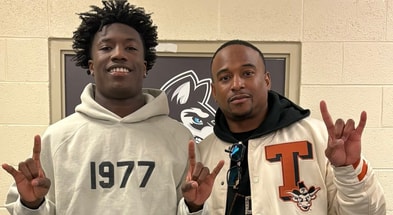
After Western Kentucky All-American offensive lineman Laurence Seymore signed with Texas on Tuesday, questions about his eligibility for the 2026 season arose. His representative, Derek Lora of 3 Strand Sports, said Seymore is finishing his degree at WKU this spring while working with the UT compliance department in an effort to be eligible for the Longhorns this fall.
[Sign up for Inside Texas for $1! Get the latest on the NCAA Transfer Portal HERE]
Lora added, “we are optimistic his case will be approved.”
But what’s his case?
On3’s Pete Nakos reported in the wake of the signing that Seymore has an extension of eligibility waiver currently in progress. Why he needs that waiver requires a little unpacking.
Let’s go all the way back to the beginning of Seymore’s college career at Miami (Fla.).
During the 2021 season, Seymore played in two games for the Hurricanes. That season went down as his true freshman campaign. Seymore returned to Miami (Fla.) in 2022 as a redshirt freshman. He played in six games and started four.
Things get a little complicated here.
In August of 2022, the NCAA announced a few changes to transfer rules. The biggest one as it pertains to Seymore was “college athletes in all sports will continue to be immediately eligible the first time they transfer, provided they notify their schools in writing during designated notification-of-transfer windows (as determined by their sport.)”
Seymore remained with the Hurricanes through the Winter 2022-23 window and the Spring 2023 window. But on August 5, 2023, Seymore entered the transfer portal in order to leave Miami. That entrance was outside of both windows.
Seymore then quickly transferred to Akron and sat a year in order to comply with the NCAA’s year in residence rule, according to a source. Despite what Seymore’s roster page on Akron’s website says, he did not see action in six games with the Hurricanes in 2023. He was in Northeast Ohio.
In 2024, he played in seven games with the Zips.
He transferred to WKU ahead of the 2025 season, where he was a second-team All-American according to the FWAA and a second-team All-Conference USA selection.
Inside Texas has learned WKU was working with the Akron compliance department during the 2025 season in efforts to obtain an extension of eligibility waiver for Seymore to play in 2026 with the Hilltoppers. Understandably, WKU efforts fizzled once Seymore entered the transfer portal on January 15.
So the on-field participation story for Seymore is…
- 2021 – 2 games – Freshman
- 2022 – 6 games – Redshirt freshman
- 2023 – 0 games – Sophomore (year in residence)
- 2024 – 7 games – Junior (Akron listed him as a redshirt junior on its roster)
- 2025 – 13 games – Senior (WKU listed him as a redshirt senior on its roster)
He’s used one redshirt year and has played in three seasons. But that year in residence is proving pesky.
How will this work?
Paperwork
Inside Texas was able to obtain Seymore’s history in the transfer portal, and it’s a little messy.
Seymore entered the portal at Miami (Fla.) on August 5, 2023. Five days later, his status was listed as “withdrawn.” In portal terms, that means he took his name out of the portal. This appears to be a clerical error considering Seymore was at Akron in 2023.
When he entered the portal to leave Akron in 2024, two “Laurence Seymore” entries dated December 10 appeared. One was for Seymore as a Miami (Fla.) football student-athlete. The other was for Seymore as an Akron student-athlete. His Akron entry’s status was changed to “matriculated” on January 24, 2025 when Seymore enrolled at Western Kentucky. His Miami (Fla.) entry was also listed as “matriculated,” though it did not receive a new “last updated” date. It remained at December 10, 2024.
His departure from WKU was straight forward. He entered on January 15 and signed with Texas on January 27. His current status in the portal is “signed.”
These procedural errors appear to be part of Seymore’s case. But they’re only part of it.
Court cases, the Sherman Act, and no precedent

No matter what his portal paperwork says, the fact is Seymore left Miami (Fla.) early in preseason camp in 2023 and enrolled at Akron shortly thereafter. He spent his year in residence at Akron without participating in games in order to be eligible for the 2024 season with the Zips.
The idea of a year in residence, and sitting out while using a season of eligibility, was unsurprisingly the target of a lawsuit filed against the NCAA in late 2023. That case dealt with players who were required to spend a year in residence after transferring a second time. The NCAA had instituted a one-time exception for transfers to have immediate eligibility following their first transfer in the aftermath of the COVID-19 pandemic. The NCAA was not interested in an exception allowing for immediate eligibility after a second transfer, but their preference was struck down in federal court.
- 1

Judge recused in Brendan Sorsby eligibility case
- 2
 New
NewAhmad Hardy speaks on rehab, Mizzou return after shooting
- 3

Lane Kiffin reveals NFL-like 'fine system' for players
- 4

Bryce Underwood back for Round 2
- 5

Bret Bielema backs CFP expansion amid debate
Get the On3 Top 10 Newsletter in your inbox every morning
By clicking "Subscribe to Newsletter", I agree to On3's Privacy Notice, Terms, and use of my personal information described therein.
In a case centered around West Virginia men’s basketball player RaeQuan Battle, several states sued the NCAA for violations of the Sherman Act in December 2023. The states got their way, as did WVU. The plaintiffs said the NCAA’s restrictions on two-time transfers violated Section 1 of the Sherman Act in that it was an “illegal agreement to restrain and suppress competition in the nationwide market for Division I student athletes’ labor in intercollegiate athletics.”
By this point, student-athletes could profit off their name, image, and likeness. NCAA rules preventing free movement, even for two-time transfers, were seen as a violation of the law.
U.S. District Judge John Bailey agreed with the states, issued a permanent injunction, and restrained the NCAA from enforcing the year in residence rule for two-time transfers.
Seymore’s issue isn’t his second transfer. He played in 2025 at WKU after playing at Akron in 2024 thanks to Judge Bailey’s ruling. It’s also not related to any scholastic problems. Seymore told Inside Texas he was never ruled academically ineligible at any of his stops.
His year in residence at Akron was required because he entered the transfer portal outside of the established windows. Without a waiver, his 2023 spent at Akron will count against his five years to play four seasons.
Whether the NCAA will grant Seymore a waiver is not yet clear. There is no known instance of a football player looking for lost eligibility because he entered the transfer portal outside of an established window.
That also means there hasn’t been a legal challenge to the NCAA for its rule requiring a year in residence, which burns a year of opportunity for a student-athlete to play and to profit of his name, image, and likeness, for entering the portal outside of the established windows.
Time will tell if Seymore will be ruled eligible without issue or if him playing in 2026 will require Texas to take matters to court.
Until then, Seymore will complete his degree at WKU and prepare for a featured role on Texas’ 2026 offensive line.