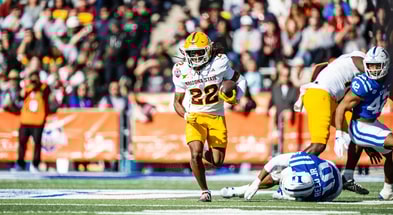
“You’re Getting a Winner”: Hines Ward backs Jordyn Tyson amid durability narrative


There is a moment in every draft cycle when the conversation shifts. It stops being about production and starts being about doubt. For Jordyn Tyson, that moment has arrived, and Hines Ward is not buying much of what is being said.
Ward has seen this before. He understands how narratives are built, how they spread, and more importantly, how they can miss the reality of a player.
“Whatever team ends up drafting him, you’re going to get a winner,” Ward said. “I know the work that he’s put into it.”
The rationale behind this belief can be found in the facts Tyson has already proven. In a 2025 season reduced to only nine appearances, he registered 61 receptions, gaining 711 yards and tallying eight touchdowns, after posting an impressive 1,100 yards and 10 touchdowns in the previous season.
Tyson’s high efficiency continued to impress, especially in man-to-man coverage, while his skill set as a receiver saw him make significant improvements in drop rates, going from 8.5% to 1.6%.
When healthy, Tyson does more than just look like an NFL-caliber receiver; he plays like one. This makes the ongoing question about his draft prospects so intriguing.
At times during the past year, Tyson was mentioned as a top-10 prospect and the first receiver selected. Currently, his draft status has been projected anywhere from the latter part of the first round to a possible fall into the second. Why? A lack of participation in pre-draft testing, lack of exposure, and, above all, a medical history including a multi-ligament knee tear, collarbone fracture, and, most recently, a lingering hamstring strain.
Ward does not dismiss those concerns. He reframes them.
“Injury-wise, listen, there’s a fluke injury with his collar bone, like three guys fell on him. The hamstring there, that happens at the wide receiver position,” Ward said.
For Ward, the bigger story is not the injuries themselves, but how Tyson responded to them. That is where he believes evaluators are missing something.
He points to a specific moment.
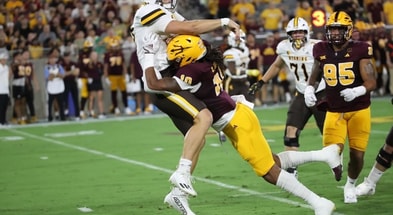
During a late-season game against No.7 Texas Tech, Tyson aggravated his hamstring in the third quarter. Ward tried to pull him out.
“I said, ‘No, man. It ain’t worth it,’” Ward recalled.
Tyson refused.
“He said, ‘Coach, man, I love my brothers. I don’t know what’s going to happen. If this is going to be my last game, I want to do all I can, even if I can’t run the route.’”
What followed, according to Ward, reshaped how he viewed Tyson.
“And he single-handedly on that last drive led us down all the way and helped us win that game. And that’s where I learned a lot about JT’s toughness, who he is as a person.”
That toughness has become one of the more debated aspects of Tyson’s evaluation, something Ward openly pushes back on.
“They try to write the narrative. He’s not physical and stuff like that. And I just laugh at it,” Ward said.
Context matters here. Tyson is not a burner in the traditional sense. He does not rely on overwhelming top-end speed. Instead, his game is built on precision, leverage, and control. He wins with routes, body positioning, and ball skills, particularly in contested situations where he converted nearly two-thirds of his opportunities.
That profile, combined with his production, is why teams remain intrigued despite the uncertainty.
Ward sees a player whose skill set translates directly.
“He’s a first round talent,” he said. “He’s going to be fine.”
The pre-draft process has simply introduced variables that teams are still sorting through. Tyson did not participate in the NFL Combine or Arizona State’s Pro Day, leaving scouts without verified testing numbers. That has placed greater emphasis on medical evaluations and film study, creating a wider range of outcomes than typically seen for a player of his caliber.
A private workout scheduled for April 17, just six days before the NFL Draft, has become a pivotal moment, an opportunity to provide clarity where questions remain.
For Ward, none of it changes the core evaluation.
“I’ve been with him on a day-to-day basis. I’ve seen him go through practice. I saw him try to come back from injuries ahead of time.”
That daily exposure is part of what makes Ward’s perspective carry weight. His own career was defined by toughness, physicality, and an ability to produce in critical moments, traits he now sees reflected in Tyson.
“It sounded a lot like myself as a player,” Ward said.
***
While Tyson’s future dominates the conversation, his impact has already shaped the present at Arizona State.
His development became a selling point.
“The common thread between all the guys that ended up here, the one keyword was development,” Ward said. “They saw JT and his growth as a football player, and they wanted to be a part of that.”
That influence is evident in a rebuilt receiver room that looks dramatically different heading into 2026.
Transfers like Omarion Miller and Reed Harris were not just additions. They were targeted pieces meant to elevate the entire unit.
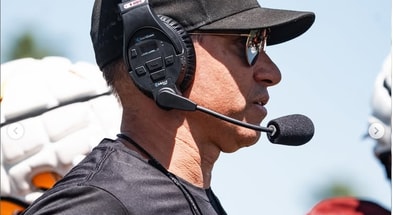
“Coach Kenny, his whole thing, objective this offseason, he wanted to make the room competitive,” Ward said.
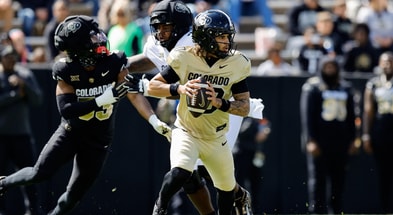
Miller comes to us from Colorado, having already made a name for himself as a player who can get things done with his explosive potential. Standing at 6’2″ and weighing 210 lbs, Miller brings the kind of vertical velocity and threat of big plays that have led to him racking up an 808-yard season and league-best yards per catch.
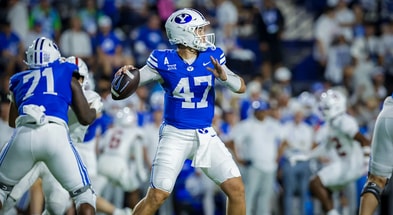
Then there’s Harris, who gives us a whole new set of challenges. Harris is 6 ‘5 ” and provides a physical mismatch in addition to being a player who can create mismatches in the red zone and on third down because of his catch radius. Also adding to the dynamic is the fact that Harris used to play quarterback, which means he can help with developing his route-running and separation skills.
Together, they reshape the structure of the offense. Tyson was responsible for carrying the load as our main guy, and in some cases, the only one who had shown consistency. Now, the new guys make sure to take care of that workload.
Ward sees that transformation happening in real time.
“I think bringing the guys that we brought in really elevated everybody’s level as far as competition,” he said. “Competition brings out the best in everyone.”
That competition extends beyond catching passes. Ward has emphasized a complete approach to the position, one that includes blocking and physical engagement away from the ball.
“That’s what the scouts look for. They don’t just look for just guys just, you know, how can you impact the game when you not catching the football,” he said.
It is another layer to the evaluation process that Tyson has already navigated and one that the new group is now embracing.
As spring progresses, Ward’s focus remains on growth, both individual and collective.
“It’s a process,” he said. “We’re getting better each and every day.”
That message applies across the room, but it carries a different weight when viewed through the lens of Tyson’s journey. His story is not clean. It is not linear. It includes setbacks, questions, and a level of uncertainty that can quickly shift perception.
But within that uncertainty, Ward sees clarity. A player who produces when available. A competitor who refuses to come off the field. A receiver whose game is built on details that translate.
And perhaps most importantly, a player whose evaluation cannot be fully captured by a workout or a medical report.
“I know the work that he’s put into it,” Ward said.