By the Numbers: Oregon Makes History and BCR Still Matters
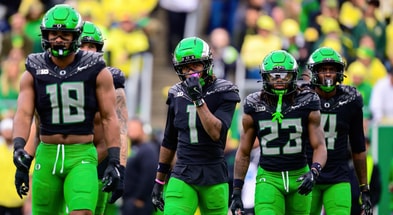
The #5 Oregon Ducks got the 23-0 win over the #4 Texas Tech Raiders in the Orange Bowl on Thursday. This was a game of dominating defense from both teams, but Oregon had just enough success on offense to get the victory.
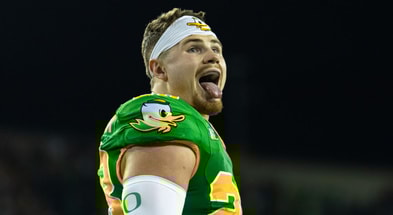
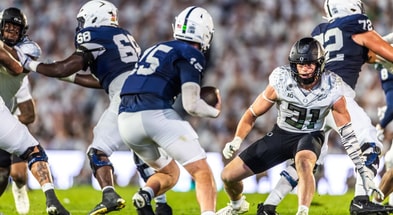
The Ducks shut down the Red Raiders so completely that they got their first bowl shutout since 1917. It was also the first shutout in the playoffs in the last 10 years. Brandon Finney Jr was a star. Teitum Tuioti boosted his draft stock, yet again. Matayo Uiagalelei had one of the most impressive athletic plays of the season.
How did the Ducks defense pitch their first bowl shutout in over a hundred years? What happened to the Oregon offense in this game? Let’s dig into the advanced stats, snap counts, and PFF grades.
Blue Chip Ratio Might Not Be Everything – But it Matters

Earlier last week I wrote about Blue Chip Ratio (BCR) and how it could affect the outcome of this game. Oregon has a BCR of 78% this season, while Texas Tech was probably around 27%. This metric seems less and less important as the transfer portal is reshaping the landscape of college football.
While no team with under a 50% BCR has won a national championship in the last 15 years since it has been tracked by Bud Elliott of CBS, this seems like a good chance with Indiana. The Hoosiers have a historically low BCR, with 0 five-stars, 7 four-stars, and 55 three-stars. If they win the championship this year it would absolutely break the mold that we have known for decades upon decades.
With that said, BCR is still relevant. Not necessarily as a measuring stick, but as an indication of depth and overall talent. This matters in a game of attrition, which the college football playoff has clearly become. If the Ducks win the natty this year, they will have played 16 games. That’s a lot of football for some college kids, many of whom are true freshmen on this team.
If you don’t think depth played a part in the game on Thursday, just look at the snap counts. Texas Tech had four players with over 82 snaps, and three more players with over 70. In total, the total snaps for the starters was 806 for the game. Oregon didn’t have a player with more than 61 snaps on defense and their total was 527.
The Ducks starters played 279 snaps fewer than Tech. A lot of that was time of possession, but Oregon was able to spread around their snaps on defense. They had 24 players with at least 1 snap on defense.
That’s depth.
Brandon Finney and the Secondary Are Elite

I asked the question after the game if a Duck defensive player has had a better game than Finney just played against Tech. There were a few names thrown out. Steve Smith in the 2001 Fiest Bowl had 3 interceptions (the Joey Harrington era!) Brady Breeze was the 2020 Rose Bowl Defensive MVP with 11 tackles, a forced fumble and a TD.
Neither of those games had the same stakes as this quarter-final matchup with Texas Tech. I remember that Fiesta Bowl and the Ducks should have been playing for the natty that year. They were snubbed and had the consolation game against Colorado. This Ducks team has a chance to do what that 2001 team didn’t get a chance to do.
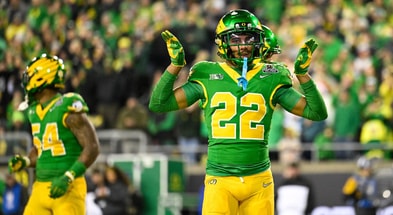
Finney ended the game with 2 picks and a fumble recovery. His defensive stats are absolutely elite. 7 targets and 2 receptions for 28 yards. He allowed only a 4.2 NFL passer rating for the game. It feels like Finney could very well go down as the best corner ever to play at Oregon, and maybe even the best defensive player in school history.
The rest of the secondary played very good football as well. Behren Morton finished with 137 yards on 18-32 passing (56%) and a RTG of 79.7 for the game. He had the two picks to Finney and zero touchdowns. Ify Obidegwu was targeted 2 times for 1 catch and 11 yards. He allowed a 66.7 NFL passer rating. Jadon Canady was only targeted once for zero yards and a 39.6 NFL passer rating.
The rest of the corners didn’t get much play. Na’eem Offord had 4 snaps and zero targets. Daylen Austin had 4 snaps and zero targets. Theran Johnson had the worst game of the bunch with 8 snaps, 3 targets and 3 receptions for an NFL passer rating of 118.8
The Offense Struggled – Especially Running the Ball

It was pretty obvious that the Ducks couldn’t get anything going on the ground. Oregon had 45 carries for only 99 yards and an average of 2.2 yards per carry. Just brutal. The Tech defense completely shut down the run for Oregon. Jordon Davison had the most success with 42 yards on 15 carries and 2 touchdowns, but he only had a 2.8 average.
- 1
 New
NewIntel on UNC's 2027 recruiting board
- 2

Final college baseball Rankings from regular season
- 3

Auburn lands four-star OT Layton Von Brandt
- 4

Tommy Moffitt is now driving Texas A&M's pursuit of a title
- 5

NCAA Tournament projections entering conference tournament week
Get the On3 Top 10 Newsletter in your inbox every morning
By clicking "Subscribe to Newsletter", I agree to On3's Privacy Notice, Terms, and use of my personal information described therein.
This was significantly worse than when the Ducks played Indiana. The Hoosiers are currently 3rd in the country at run defense, allowing 77.6 yards per game. In that matchup back in October, Oregon was still able to get 116 yards on 24 carries and a 4.8 average. Davison had 59 yards on 8 carries for a 7.4 average. Will Stein just went away from the run for some inexplicable reason.
This was not the case against Tech and their #1 run defense. The Red Raiders completely shut down the run in this matchup, but unlike the game against Indiana, the Ducks persisted. They had 45 carries against Tech, and only 24 against the Hoosiers. You can’t abandon the run completely or it makes your offense significantly easier to defend. Oregon also had the advantage of not playing from behind in this one.
The Ducks absolutely have to have a run game against Indiana in the next round. They can’t have a repeat performance of this game and the game in October if they want to win.
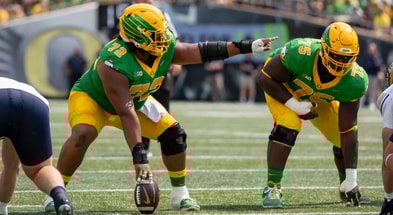
The Offensive Line Struggled – But They Got Some Help

One of the biggest issues against Indiana was that Dante Moore was sacked six times and Oregon struggled mightily to protect him from that potent Hoosier defense. While the interior offensive line had some success, the tackles had a lot of trouble in that game, and the running backs also had season-low performances on pass protection.
In that game, Noah Whittington had a 30.7 pass block grade from PFF. He averages 79.8 for the season. Jayden Limar had a 40.3 pass block grade. He hadn’t dipped below 70 all year. Jamari Johnson also had a very bad grade for that game with a 40.7, which is close to 30 points lower than his 70.2 seasonal average.
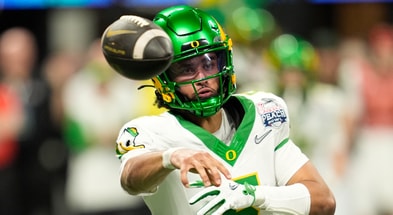
This time, against Texas Tech, the running backs and the tight ends showed out. Whittington had a 81.3 grade – the highest on the team. Jordon Davison had 75.9, Jamari Johnson had 72.8, and Kenyon Sadiq had 71.3 for the game. The offensive line struggled, and gave up those two sacks in the first half, but the Ducks figured it out and kept Dante Moore clean for the rest of the game.
Moore was only under pressure on 10 drop backs in this matchup. The Ducks kept him clean on 29 of his 39 drop backs against the Red Raiders. When he was clean he had a 80.8% completion rate for 195 yards. When he was under pressure he still completed 71.4% of his throws but his yards per attempt dropped to 5.6 and he had a pick.
The Ducks need to keep him clean against Indiana.
Other Notables
Dakorien Moore had 36 snaps in this game, which would indicate that he’s pretty much back from his injury. Gary Bryant Jr had 18, which could indicate that Oregon is bringing him along slowly, or they just don’t need him right now.
On defense, the Ducks were able to spread around the snaps to some of their young guys. Terrance Green had 18 snaps, Tionne Gray had 17, and Ashton Porter had 16 for the defensive line. Also Dorian Brew got his one and only snap of the season.
We did not see Trey McNutt make his first appearance in an Oregon uniform.