Willing to Fight: Louis Moore’s unconventional path to college glory and an NFL opportunity

At first, he worried that a family member had died.
In three weeks, Louis Moore was set to begin his seventh season of college football. He was preparing just like he could any other season, working out under the muggy July heat of Bloomington, Indiana.
While he was participating in drills on the practice field adjacent to Memorial Stadium, he heard his voice from across the turf.
“Lou!” an Indiana staffer shouted. “Come here. Grab your stuff and come inside.”
The safety was confused. His mind raced. “Had something happened at the house?” he asked himself.
What was waiting for him once he got inside of the stadium was a phone call. It wasn’t his mother. It wasn’t another family member or loved one. It was news from the NCAA.
Moore’s eligibility was in question, and the NCAA was going to deny him the ability to play during the 2025 season. It argued his final year in community college would count towards his eligibility, and that he had used the other three between his two years at IU and one at Ole Miss.
If Moore wanted to finish out his career as a member of the Hoosiers, he would have to fight. If he wanted to continue his dream of playing in the NFL, he would need the NCAA’s decision to be reversed.
In order to do so, Moore had two choices: he could appeal his eligibility case through the NCAA and have the organization give it another look, or he could sue.
“I ain’t gonna sue nobody,” Moore thought at first. But then came a realization. If he simply appealed, the NCAA could just say no. His college career would be over. If he sued, the NCAA would have to make its case just like he would. Both sides would have legal representation. Both would be on equal footing.
He couldn’t risk his future being decided by the NCAA. In order for his life’s work to continue, Moore wanted to prove his case. Prove that he deserved one more year of development, one more year of searching for collegiate success, and one more year to make his pitch to potentially live out his aspiration of NFL football.
“I needed this year back,” Moore said. “I needed to show what I can do.”
Because if he didn’t get to play in the 2025 season, his football career – and any hope at playing professionally – would be over. Since he first joined a peewee football team at the age of four, football had been what he loved most. And suddenly, it was on the brink of being taken away from him.

***
He wondered why he kept getting passed up.
LaVonda Moore and her son drove across the state of Texas, trying to get the attention of bigger programs. Showcases, recruiting events, anything. In the end, no offer better than Division 2.
“Mom, I’m better than this,” Louis told her.
“I know you are,” she said back.
Moore was a talented student-athlete at Poteet High School in Mesquite, Tex., and a member of the football, basketball and track teams. Yet, he and his mother felt like he was always undervalued after not becoming a varsity starter until his senior year.
“He was always the next best,” LaVonda said. Louis was even the runner-up for homecoming king as a senior.
Despite playing three sports, Louis always knew football was his ticket to success – but that ticket wasn’t getting punched like he expected it to. Without enough varsity tape until his final year of high school, his recruiting was extremely late to materialize, leaving Louis and LaVonda in need of getting his word out there.
In the end, no D1 offers came his way no matter how many programs they contacted.
With few options, Scott Parr, head coach at Navarro College called the Moores. He gave Louis an offer, but it wasn’t exactly what he had been looking for.
The NJCAA offers two years of eligibility. That’s it. Moore would get two seasons of football to show he belongs at a higher level. Just a maximum of 20 games to keep his dream afloat – but it was better than nothing. Moore still had a sliver of hope to prove his worth, and he was going to take it.
“We were probably just the best opportunity he had at that time,” Parr said. “He believed in himself. He took a chance on himself.”
The alternative would be going to a NCAA D2 school – where the seasons spent playing fully count towards D1 eligibility – or quit football altogether, and that was never going to happen.
Moore had his mind set on becoming great, even if that meant his collegiate journey starting in the NJCAA. So in the fall of 2019, Moore became a Navarro Bulldog. It was far from where he thought he would be out of high school – instead of a massive stadium with real NFL visibility, he instead was headed to play at a partially mowed grass field that was barely better than the one he used in high school.
His dream of playing big-time football was far, far away, but he would continue playing football, and that was all that Moore needed.
***
He believed he was lost.
“Like what’s going on, like what do I have to do?” Moore thought.
He was 21 and had been a part of Navarro’s football program for three years. He had gone through a redshirt season in 2019 where he didn’t see the field, a 2020 season moved to the spring because of COVID, a misdiagnosed ACL tear and a positional change to defensive back ahead of the 2021 campaign.
On his 21st birthday – an age where many college players enter the NFL Draft – Moore still didn’t have a D1 offer. He still celebrated turning 21 on January 29, 2022, but as far as his career was concerned, there were few reasons to remain optimistic.
But he still believed that he was destined to play at a higher level. Every decision that Moore made was to get noticed, to improve his chances of extending his career any way he could. He rehabbed his ACL on his own because Navarro didn’t have a full-time trainer for football. He switched positions, hoping that playing defensive back would help him catch the eyes of a bigger program.
Moore was willing to do whatever it took, and once he got out onto the field, he was going to be relentless. In the final game of the 2021 campaign, it appeared as if Navarro’s season was over, but Moore put everything he had into a moment that embodied the perseverance that allowed him to get through the peaks and frequent valleys of his JUCO career.
Cisco College was up by two with less than 90 seconds left. A couple of kneels and the game was over. No postseason for Navarro, and Moore’s JUCO career would be over. – a possibility that his football career could be over.
“It was game,” Parr said. “I turned my headset off.”
But Cisco opted to forgo victory formation, and run the ball up the middle. That’s when Moore took out his frustration, and put the game in his own hands. On a running play with less than a minute remaining, he got past the offensive line and into the backfield. He stripped the football from the rusher, and took it nearly 30 yards for a scoop-and-score touchdown.
Instead of a disappointing end to the season, Moore was able to execute a miraculous play to put Navarro up by five. Navarro was going to the Scooter’s Coffee Bowl, and Moore was a hero.
He, his mom, and Parr believed this was the moment that would land him a major offer, allowing Louis to continue playing football. “He was in tears,” LaVonda said.
His next step was to get that offer, and it appeared like everything was falling into place. Moore was in the SMU football offices after the 2021 season and thought he was about to finally get his chance — his opportunity to play where he felt he belonged.
“This is what I had been waiting for,” he thought. But then his potential offer never materialized.
SMU’s head coach Sonny Dykes moved on to TCU, and the new staff under Rhett Lashlee didn’t see the same potential in the defensive back. Moore left Dallas with a blank page, still no offers to speak of after his hopes were as high as they’d been up to that point in his career.
Moore had been there before. All hope was seemingly lost during his senior year of high school, but he found a way to continue playing. In the matchup with Cisco, Moore kept fighting, and singlehandedly flipped a loss into the victory, extending his final Navarro season by a game. Every time there was a threat to his football career, Moore kept on working, kept on believing. But this time, it would be the strength to wait, and hope D1 offers would come.
And with patience, came what Moore was waiting for. His recruitment started to pick up once the calendar shifted to 2022. Some FCS programs around Texas sent offers, then what Moore described as “the whole Sun Belt” wanted to sign him. Central Michigan was an intriguing offer, but once Indiana entered the field, Moore’s attention was shifted towards Bloomington.
He committed to Tom Allen’s program in May of 2022. Moore was going to be a Division I football player, a Big Ten athlete. His dream had finally come to fruition, and another step towards an NFL future was achieved.
“He was ready,” LaVonda said. And this was Louis’ moment.
But two years later, he was back in the transfer portal. Allen was fired. Curt Cignetti came in with a vision of changing Indiana football — and changing it quickly.
Moore considered continuing his Indiana career under new leadership, but he eventually opted to seek a change of scenery. “Let me go take a chance on myself,” Moore thought.
In December of 2023, he committed to play for Lane Kiffin’s Ole Miss Rebels – another opportunity to showcase his talents in hopes of making the College Football Playoff and playing in the NFL.
But 11 games played later, Moore entered himself back in the transfer portal. Things didn’t work out in Oxford, with Moore starting just two games in total – not enough to show what he was made of to professional scouts. The NFL couldn’t have been further from being a plausible next step, so a return to college football was the only option for Moore to continue playing football.
“He was told from Ole Miss that he was granted another year of eligibility,” his mom said. One more year to put it all out on the field. A last-ditch attempt at obtaining a pro career, and a final shot to experience all that college football has to offer.
Moore fielded calls from several programs, but one stood out: Indiana. The place that gave him his only chance at Power Conference football after JUCO. He was drawn to a return, and in December of 2024, Moore made it official.
In his seventh season of college, Moore would once again be an Indiana Hoosier. He was grateful to keep his career alive, something he had been fighting for throughout the past four years. And in that time, Indiana was where Moore felt most comfortable, where he believed he could put together a season that gave him an opportunity at the NFL and succeed at the highest level of college football.

***
He was going to be the plaintiff.
Moore opened his laptop and logged onto Zoom. He joined a video call in his apartment in Bloomington, with the other line being back home in Texas. He was a part of Moore V. NCAA, his fight to get his final season of eligibility back.
He was asked question after question and needed to deliver an answer. The pressure was immense — these responses were going to determine if he could continue working towards his goals as a football player.
“I didn’t understand what they were talking about,” Louis said. “I didn’t know what they were talking about; a lot of stuff they were saying, they were just going back and forth.”
In Dallas County District Court, Louis Moore filed suit against the NCAA with the intent to play the 2025 season at Indiana. Represented by attorney Brian P. Lauten, Moore’s case was predicated on the fact that the NCAA denying his waiver to play football was in violation of Texas Antitrust Law.
Moore could practice under a temporary restraining order, but during the four-week period of fall camp — the official designated practice period after unofficial summer workouts — Moore missed significant time while the rest of the team was preparing for the season.
Out of three scrimmages during the fall, Moore didn’t suit up for any of them. He was demoted to the second unit, as his lack of availability forced IU to establish a backup plan.
“The coaches communicated with me,” he said. “They were like, this is a possibility that I won’t be playing this season.”
“I ain’t going to dispute that,” he responded.
That thought of his career ending abruptly kept eating away at Moore. His chance at proving his worth to NFL franchises may have been running out, and there was nothing he could do about it.
- 1

Ed Orgeron returns to LSU on Lane Kiffin's staff
- 2

Judge recused in Brendan Sorsby eligibility case
- 3
 New
NewAhmad Hardy speaks on rehab, Mizzou return after shooting
- 4

Lane Kiffin reveals NFL-like 'fine system' for players
- 5

Bryce Underwood back for Round 2
Get the On3 Top 10 Newsletter in your inbox every morning
By clicking "Subscribe to Newsletter", I agree to On3's Privacy Notice, Terms, and use of my personal information described therein.
“It was very stressful,” he said. “I started journaling to get the thoughts out of my head.” Moore leaned on his mother throughout the whole process, as well as Lauten. The two got close, and not just within the lawyer-client relationship.
The uncertainty, the unknown, and the fact that all of this was out of Moore’s control was nerve-wracking. All that they had worked toward could be gone in an instant, and there was nothing that Moore could do — it was up to Judge Tillery to decide.
“We’re gonna pray, and we’re gonna keep on moving,” LaVonda told Louis.
***
He jogged out onto the field at Memorial Stadium.
On August 30, Moore started Indiana’s Week 1 matchup against Old Dominion. He was eligible, at least for now.
Judge Tillery gave Moore an extension on the TRO that was keeping him eligible for competition. It was extended until September 10 — good for the first two weeks of the 2025 season.
In Weeks 1 and 2, Moore found success on the field, as well as progress made emotionally. When Moore was on the field, he was just playing football. No stress, no outside thoughts, no worries about his future. It was his happy place, a peaceful environment despite 50,000 screaming fans. It was football — and Moore found solace in it.
Off the field, though, it remained tough for him. “Damn, I got to go back to court, I got to go back to court, and, like, figure it out,” he thought. But playing football offered a way for him to get all his emotions out.
Non-game days were still especially taxing. He was putting up numbers in the games, but outside of the regular season contests, he wasn’t 100% mentally there. Even Cignetti called him out, challenging him to be better outside of game days.
“He’s got to practice better, he’s got to prepare better. He’s got to play with more urgency,” the head coach said ahead of the Week 3 matchup with Indiana State
On September 9, a day before the hearing was scheduled to determine whether Moore could play for the rest of the season, the attorneys reached an agreement. Lauten, along with NCAA counsel Taylor Askew, each agreed to push back the hearing until September 24, with Moore remaining eligible until then.
He could play — but only for two more weeks. There was still nothing officially finalized, but this decision was different. Lauten and Moore knew the NCAA was scrambling. They didn’t have much of a case.
The preliminary hearing was spent talking about the case being tried in Texas versus Indiana. Askew attempted to dismiss the case in Texas, with the option to re-try the case in Indiana, but Judge Tillery wasn’t receptive. And after Moore’s TRO was extended once more, everyone in his camp could see the writing on the wall.
“Oh yeah, they just messing around now,” LaVonda told Louis. “You getting cleared for four games, you’re in there.”
Louis and his mom knew deep down that he was going to be able to play his final season of college football, even though he hadn’t officially received the injunction yet.
But on September 24, that injunction was written into law. Judge Tillery ruled that the NCAA didn’t have enough of a case to dismiss Moore’s lawsuit. This wasn’t technically a win in court, as no formal decision was made, but it was all Moore needed to be eligible for the rest of the season.
Seventy-three days later, on Ohio State’s first drive in the Big Ten Championship Game, Moore picked off Julian Sayin’s pass deep in Buckeye territory. And with that. Indiana proved it belonged against the then-No. 1 team in the country, just like Moore proved he belonged on the field with the Hoosiers.
And he certainly took advantage of the opportunity given to him. Moore was named first-team All-Big Ten and a second-team All-American as one of the most important leaders on the first Indiana team to finish a regular season 12-0.
“I was playing more free,” he said. Without the legal burden weighing on him, Moore unleashed the best season of his career — a season that allowed him to start appearing on NFL Draft boards. In addition to earning a spot in the national spotlight on the undefeated Hoosiers headed to the College Football Playoff, he was seeing his professional dreams slowly come to life.
Just a few months ago, Moore’s career was on the verge of crumbling. Now, he was on the precipice of what he imagined he would be doing throughout every step of his college career. His unusual path was never an easy one, but he put his head down and earned himself a season that was worth fighting for.
“It’s going to come to fruition; everything you want will come to fruition,” Moore said to himself.
***

He missed a tackle on the final play of his college career.
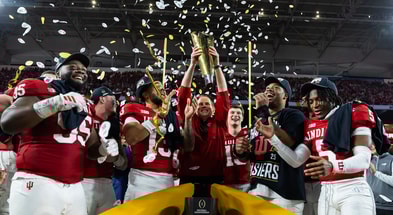
And yet, it wasn’t a tackle at all. Jamari Sharpe had the football, seconds after he intercepted Carson Beck’s pass to seal a national championship victory. Moore was the first of the Hoosiers to embrace Sharpe, doing so by attempting a hug — mimicking a tackle — after Sharpe took a knee at the 7-yard line with the football in his arms.
That was it. The Hoosiers were national champions, and Moore was right there. He and Sharpe both began to sprint toward the northeast corner of Hard Rock Stadium, with more and more teammates joining in. The Hoosiers knew they were champions, and for Moore, his career ended with a moment that satisfied everything he had gone through to get there.
From being doubted as a youth football player to getting zero offers from D1 programs out of high school. At Navarro, he navigated a COVID season and a torn ACL with no training staff, all while trying to find the right fit to jump to the Division 1 ranks.
A coaching change caused him to transfer, but he didn’t find his footing in his new home at Ole Miss. He eventually returned to Indiana, where he believed he could succeed in his final season of college football. But then came the news that he wasn’t eligible, forcing him to speak in court hearings just to continue his dream. The uncertainty ahead of the season, during the first two games, then the next two games — and then:
A victory.
Indiana had 16 of those during the 2025–26 season. Louis Moore had 17. The win in his court case may have been the most important. It allowed his career to continue and kept his dream of playing in the NFL alive. That had been his goal from the moment he stepped on the peewee football field in Mesquite.
Louis knew that if he had not been able to play during the 2025 season, he would have been scrambling, not knowing what he was going to do with his life. His football career would have been cut short, and a shot at the pros would have been slim to none. “I would have been done,” he admitted.
As Judge Tillery slapped his gavel down in that courtroom in Dallas, announcing that Louis could play for Indiana, it paved the way for another announcement.
But it never came.
Despite Moore’s chances at becoming a 2026 NFL Draft pick looking promising, all 32 NFL team caps remained unworn throughout the final weekend of April. Moore went undrafted, and experienced a familiar feeling from the majority of his past.
He was going to have to prove himself, again. But more adversity doesn’t discount what Moore has accomplished up to this point in his football career.
“It was special,” Moore said of his journey. “Everything I dealt with, it was worth it in the end.”
His college tenure found its happy ending, but his quest to find NFL success is only beginning. Signed as an undrafted free agent by the Miami Dolphins at the age of 25, Moore has his chance to make a professional roster.
This time, there won’t be a court case to determine whether he can make Miami’s 53-man roster, but Moore is still chasing an NFL dream all the same. He’s prepared to fight to make an NFL roster until he can’t anymore.
That reality almost came in high school, and then in JUCO, and throughout his D1 career. It almost came inside a courtroom in Dallas, but still, Moore was able to continue working toward his ambitions.
It would’ve taken a court order to take Moore off the field, but instead, he’s just going to keep on playing football. Because that’s all Moore has ever wanted to do.
Make sure to follow and subscribe to all TheHoosier social media platforms so you never miss any of our content on X, Facebook, YouTube, Spotify, Apple Podcasts, and Pocket Casts.