A Lawyer’s Perspective: Breaking Down President Trump’s Latest NCAA Executive Order

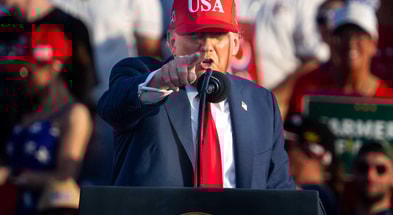
One day before the NCAA Men’s Basketball Final Four, President Donald Trump issued another Executive Order designed to “Save College Sports.” It is the second Executive Order President Trump has issued on NCAA Athletics since his original EO on the subject was published in July 2025. For those reading this article, I am not going to get into politics or discuss President Trump as a sitting president. I am simply going to discuss the text of the Executive Order, what a sitting president can and cannot do regarding NCAA Athletics, and my thoughts on the order’s legal impact under current black letter law. I’ve included the order’s text below for anyone interested. I’ve also included my article below about President Trump’s first Executive Order on NCAA Athletics from last summer.
What is an Executive Order?
In a nutshell, an Executive Order is a directive issued by a sitting president to a federal agency or agencies regarding the enforcement of federal law. Executive Orders can be traced back to George Washington, our nation’s first president. Every single president has issued at least one during their administration. When a president issues an Executive Order, the president does not need to obtain Congress’s approval, and only a sitting president can overturn an Executive Order with a subsequent order.
Here’s where things get confusing. While an Executive Order is published in the Federal Register, it is not legislation. An Executive Order cannot create new law. This safeguard is in place to prevent presidents from creating their own laws on a whim without Congressional oversight. Executive Orders can only direct federal agencies to enforce already existing federal law. Executive Orders can be extremely useful tools for sitting presidents in scenarios where the Federal Government has extensive regulations in a specific subject area. Conversely, Executive Orders have little to no impact in areas where the Federal Government has very limited legislation or none at all.
For example, the Federal Government has extensive regulations in maritime law, and the U.S Coast Guard enforces them. So if a president issued an Executive Order directing the U.S. Coast Guard to enforce only some existing maritime laws while not enforcing others, the Executive Order could have a sweeping impact and would remain in effect until another sitting president overturned it.
A couple of clarifying points about the Supreme Court and the House Settlement
There is still a lot of confusion out in the NCAA social media universe about the Supreme Court case NCAA v. Alston and the House Settlement. That confusion pops up every time there is a major court case, as well as President Trump’s two EOs.
The Court case NCAA v. Alston was not about NIL. It was about internships and education-based payments issued to student-athletes. The impact of Alston was to end a decades-long standard under which courts would defer to the NCAA when it enforced its rules in antitrust lawsuits. As a brief refresher, antitrust lawsuits are brought when an entity is accused of having a monopoly in a market for trade or commerce. In NCAA cases, antitrust lawsuits are common because players often argue that the NCAA’s rules give it a monopoly by unfairly restricting trade and commerce in College Athletics.
In Alston, the NCAA now faces a multi-level test when its rules are found to have anticompetitive effects in antitrust lawsuits. In this test, known as the “rule of reason,” the NCAA must show that its rule has a legitimate pro-competitive rationale and is not arbitrary. Sometimes these lawsuits involve NIL. Sometimes they involve eligibility. Regardless, if a player brings a claim under federal antitrust law against the NCAA, a court will apply the “rule of reason” in deciding the case.
One reason why the NCAA hates the Alston case is that the “rule of reason”, when applied to several NCAA rules, would render those rules unlawful. In particular, the NCAA’s emphasis on amateurism and its belief that players should primarily compete for “the love of the game” takes a beating under the “rule of reason” test. Look no further than this part of Judge Kavanaugh’s concurring opinion in the Alston case. A few months ago, I found this post on Twitter about Alston, and I’ve been waiting to use it for an article like this one. Although Alston was not about NIL payments, this excerpt highlights how problematic the “rule of reason” test is for the NCAA, given its business model.
The other point I wanted to clarify was about the House Settlement. The House Settlement was not a court decision. Several NCAA representatives and several former NCAA athletes voluntarily agreed to it. The House Settlement is the current framework the NCAA uses for its NIL rules. It is not federal law, as the NCAA is a private organization. Judge Claudia Wilken, a Federal Judge in the 9th Circuit, oversaw the House Settlement, but did not order the parties to enter into it. She merely served as the referee and ensured that the terms of the settlement were consistent with federal antitrust law.
The Executive Order explained
Earlier this year, President Trump hosted a “College Sports Roundtable” at the White House, where several conference commissioners (including the SEC’s own Greg Sankey) and former coaches met with the President to discuss the current state of NCAA Athletics. President Trump revealed several of his stances on NCAA Sports, which were notably anti-player. These views included a desire to return NCAA sports to the “old days” where players were not paid and only received scholarships, where players could not transfer to different schools in consecutive seasons, and blamed the problems facing NCAA athletics on multiple judges who have ruled in favor of NCAA players in specific court cases.
President Trump’s Executive Order from April 3, 2026, generally follows the spirit of his NCAA Athletics roundtable. Section 1 of the Executive Order claims that the NCAA rules institute order and consistency and have been weakened and nullified by judicial rulings and State legislatures, who have “undermined competition, reduced opportunities for student-athletes, and jeopardized support for the current range of college athletics. The President ended Section 1 of his Executive Order by calling on Congress to issue prompt legislation to preserve the future of NCAA Athletics.
In Section 2 of the Executive Order, President Trump laid out a proposed timetable for his reforms to NCAA Athletics. President Trump listed August 1, 2026, as the effective date for Sections 3-6 of the Executive Order and expressed hope that federal agencies would be prepared to implement its requirements by that date.
Section 3 of the Executive Order lays out a series of definitions for “Fraudulent NIL scheme” and “Improper financial activities.” The latter is defined as intentionally participating in a scheme for the improper use of NIL agreements, using NIL funds to pay coaches, recruiters, or other individuals coaching or managing a team, and tortiously interfering with a contract between a student-athlete and a federally funded higher education institution. Section 3 defined a Fraudulent NIL Scheme as a scheme to pay for NIL services above the fair-market value of a player’s NIL services.
Section 4 addresses efforts to preserve Women’s and Olympic sports. A key provision is President Trump’s desire that the NCAA, pursuant to applicable law and court orders issue rules that establish (1) age-based eligibility rules, (2) athletes have up to 5 years to participate in NCAA Athletics, (3) that professional athletes cannot return to NCAA Athletics, and (4) that athletes have one free transfer during their five year eligibility window.
Section 5 concerns the Attorney General and directs the Attorney General to prosecute claims against state laws that conflict with NCAA rules and violate interstate commerce. Section 6 allows for federal agencies to, when appropriate and consistent with current law, seek input from leaders in college athletics and other experts regarding the implementation of the Executive Order. Section 7 of the Order contains a severability provision which preserves the remainder of the Executive Order if any portion of the order is deemed unlawful. Section 8 states that the NCAA, consistent with applicable law, shall implement the Executive Order.
The Legal Merit of President Trump’s Order
On its own, the Executive Order does not change the status quo in NCAA Athletics. The current NCAA rules remain in place regarding the transfer portal and player eligibility. No new rules have been enacted.
As I wrote above, this Executive Order is not a law. There is no federal legislation on NIL or the transfer portal. As such, President Trump cannot direct U.S. federal agencies to enforce NCAA rules regarding NIL and/or the transfer portal because no such federal laws exist. The NCAA is a private organization, not a federal agency.
Theoretically, President Trump could try to enforce the order through the Department of Education. NCAA member institutions receive federal funding through the Department of Education. As an enforcement mechanism, President Trump could direct the Department of Education to cut funding to universities that do not comply with the Executive Order. The problem with that strategy is that courts have historically ruled against presidential Executive Orders when they lack a sufficient legal basis.
I think President Trump’s Executive Order lacks a sufficient legal basis to survive in court. I believe this is the case for several reasons.
One problem the Executive Order faces is that it grants a deferential standard to the NCAA and violates federal antitrust law, particularly with President Trump’s proposal of a single transfer rule. This deferential standard, if enforced by the NCAA or the Department of Education, contradicts the “rule of reason” in NCAA v. Alston. The transfer rule violates antitrust law under the “rule of reason” because a restriction on player transfers would limit roster movement, reduce players’ ability to obtain increased NIL money by switching schools, and decrease competition by heavily favoring larger, more established programs through roster retention. While it’s just one small example, the proposed transfer rule change would be found by a court to undermine the entire spirit of the “rule of reason” in the Alston case.
Another issue that the Executive Order has is based on contract law. Generally speaking, NIL agreements, which often involve the transfer of athletes, are contracts between consenting parties. Whether it is a school and a player, an NIL collective and a player, or a third-party business and a player, all of these agreements fit that description. As noted above, there is no federal law governing NIL or player transfers. Neither a sitting president nor a federal agency, such as the Department of Education, can override contracts between consenting parties when there is no governing federal law on the subject of the contracts. If President Trump’s administration pursued this strategy, it would not go well in a courtroom.
Section 8 of the Executive Order presents another problem and a gigantic legal landmine for the NCAA. This portion of the Executive Order instructs the NCAA to apply the Executive Order and enforce NCAA rules pursuant to applicable law. The problem with that instruction is that the proposed rules in the Executive Order and several NCAA rules have been found by U.S. courts to violate federal antitrust law. Therefore, while this enforcement instruction may sound logical on paper, it complicates the NCAA’s implementation of the order and exposes it to lawsuits if it attempts to enforce the entire Executive Order.
There are also other potential legal battles ahead involving the First Amendment, the Commerce Clause, and the Equal Protection Clause if the U.S. Government under President Trump decides to enforce the Executive Order through the Department of Education. Each of these topics has its own potential rabbit hole, so I’ll address all three briefly. These would only apply if the U.S. Government got directly involved through the Department of Education and penalized players in some way. Because the NCAA is a private entity and not part of the federal government, it could not be sued directly on these issues.
Let’s start with the First Amendment. Technically speaking, NIL deals that involve player advertising could be deemed commercial speech, which does have some protections under the First Amendment, so long as the commercial conduct is truthful and does not mislead the public. If the U.S. government were to try to restrict NIL payments to players, a player-led lawsuit would likely raise this issue, given the frequency of commercial speech in NIL deals.
Another potential legal frontier is the Commerce Clause if the Attorney General tries to invalidate a state NIL law. Generally speaking, Congress is considered the ultimate authority on matters of interstate commerce under Article I, Section 8, Clause 3 of the Constitution. Interstate commerce is the exchange of goods and services between persons or entities in different states. NIL payments often involve interstate commerce with an athlete from one state being paid money by a state university in a different state.
In this scenario, it would be difficult for the U.S. Government to show that state NIL laws directly violate the Commerce Clause because there is no express federal law on NIL. Instead, the U.S. Government would probably need to prove its case under the “Dormant Commerce Clause.” The Dormant Commerce Clause is the principle that states cannot enact laws that unduly burden interstate commerce, even in the absence of federal law. For there to be a violation of the Dormant Commerce Clause, which is not explicitly written into the Constitution, the U.S. Government would need to prove that a state NIL law discriminates against interstate commerce and that the benefits of the state law do not outweigh its discriminatory impact. These cases can be hard to prove, and the U.S. Government could risk pissing off an entire state’s voters by trying to eliminate a state law designed to benefit one or more state schools.
Equal Protection is another potential legal landmine if the U.S. government decides to penalize players directly through the Department of Education. Under this legal theory, players could sue under “rational basis scrutiny” because the government is targeting some college students (athletes) but not others. Because college athletes are not a protected class, such as a racial group or gender, “rational basis scrutiny” would be the applicable legal standard. Although it is the most lenient standard to which government acts are held, the players could win if the government cannot show any legitimate governmental interest. For example, players could argue under this theory that transfer restrictions are arbitrary because other college students can transfer freely between schools. Because of the NCAA’s supposed emphasis on education, I think the U.S. government could have a tough time pushing back against this argument if the players raised it in a lawsuit.
The future of NCAA Athletics: Four potential paths forward
Overall, I see four potential paths forward regarding the Executive Order. Continued litigation involving players and the NCAA, lawsuits involving the players and the Department of Education, Congressional legislation, or some form of collective bargaining agreements. Of all of these outcomes, I see the first two as the most likely.
Based on the NCAA’s public statements and those of several conference commissioners, the NCAA appears emboldened by this Executive Order, and it could attempt to enact President Trump’s proposed rule changes into its bylaws. Such a move by the NCAA would result in several lawsuits by players in state and federal courts across the country. Because these lawsuits are fact-specific and involve different courts, results will continue to vary by court and judge. While I like the players’ chances in these lawsuits, there’s always a possibility that the NCAA could win in some cases. It would be a continuation of the litigation era we currently live in and would do little to promote the certainty and uniformity that President Trump’s Executive Order reportedly seeks.
As I mentioned earlier in this article, I could see President Trump instructing the Department of Education to sanction institutions and/or players who do not comply with this Executive Order. For the reasons I stated above, this strategy would lead to more lawsuits and would probably not go well for the President in court. If this strategy is pursued, a federal court is likely to hold that the Executive Order lacks sufficient legal basis.
Another potential path forward is Congressional legislation. Currently, the SCORE Act is dormant and has no imminent chance of passing. The SCORE Act is the only current piece of federal legislation with any chance of passing. The SCORE Act remains unpopular because it is almost entirely pro-NCAA and would roll back several positive developments for players over the past five years. Unless something drastically changes, don’t expect any federal legislation coming down the pike.
The fourth and final path forward is the most sensible for all parties, yet the NCAA continually avoids it. That path is collective bargaining agreements between players and the NCAA. Given the differences among specific NCAA sports, I think these agreements should be tailored to each sport. With collective bargaining agreements, players and the NCAA could agree on the rules. There are several professional models that the players and the NCAA could borrow from that would make sense. It would prevent endless litigation and eliminate the need for federal administration, which could also create more lawsuits. However, the NCAA continues to refuse to cede any ground to the players, and the players remain too focused on their individual brands rather than organizing by sport and leveraging their collective power.
NCAA Athletics are uniquely American and impact people across the entire country. In my opinion, as a sports fan and as a legal professional, these issues are too large for one person to decide or for legislation to be passed where one side is not at the negotiating table. Ironically, if this Executive Order ends up in a courtroom, I think it could lead to even more legal losses for the NCAA, undermining President Trump and the NCAA’s goals.
For now, because of the hardline stances of the powers that be, we can expect more lawsuits and legal bills. It doesn’t have to be this way, but the war between the NCAA and its players shows no end in sight. There’s a common saying: “Those who do not learn from history are doomed to repeat it.” As it currently stands, the NCAA appears doomed to end up in a courtroom for the foreseeable future.
TDR Hats BACK IN STOCK
Click Here to go to TDR’s all new store
TDR Collabs
NIL Store
Visit Nil.Store/DOREREPORT15 and use code DOREREPORT15 at checkout for 15% off your order
Great NIL gear from your favorite Vanderbilt athletes
Rhoback
Click Here to shop for Vanderbilt gear on Rhoback.com
Use Code VAN20 for 20% off your first order