How a team dinner showed Josh Schertz his Saint Louis team can be special

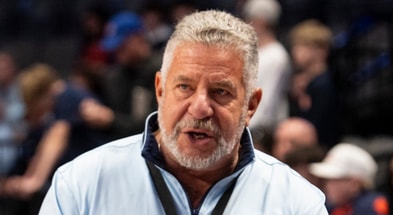
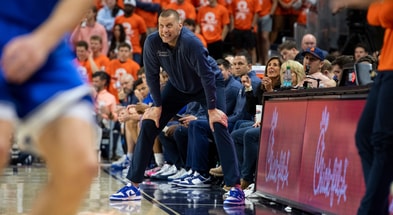
Even after a massive road win at VCU earlier in conference play, Saint Louis head coach Josh Schertz was still uneasy.
He knew a potential let down game was coming up at La Salle on Saturday. He knew his team still had work to do. But suddenly, at a team dinner in Philadelphia, Schertz realized his team will be just fine.
“We go to dinner, and I thought we were going to get kicked out,” Schertz told The Field of 68. “The guys were so loud with each other, and they were laughing and arguing and joking. No one had a phone. And I looked around at my wife and I said, ‘We’re going to be fine.'”
Turns out, Schertz was right. The Billikens walked out of La Salle with an 84-72 victory, and that’s been just one stop in a season that has evolved from promising to remarkable.
Currently, the Billikens are ranked No. 21 in the AP Poll. They’re sitting at 19-1 overall, 7-0 in the A10 to stand alone atop the conference. They’ve won 13 games in a row, and if it weren’t for Stanford’s improbable buzzer-beater in November, we could be talking about Saint Louis possibly running the table.
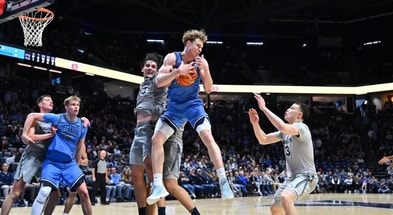
On Friday, the Billikens had their loudest statement yet, running St. Bonaventure out of its own gym in a 97-62 rout where Saint Louis tied a school record with 19 made 3-pointers. The result gave Saint Louis its best start in program history, and it pushed the Billikens’ average margin of victory in conference play to 18.6 points.
If you look at Saint Louis’ analytical profile, there’s a lot to like. The Billikens play fast, share the wealth, shoot a ton of threes and layups while making them at an elite clip. And then defensively, they keep you off the offensive glass and run you off the 3-point line. That sounds like a team that’s capable of winning a couple NCAA Tournament games.

But what has made this group so special isn’t what you see on the court. For Schertz, it’s the competitive makeup of his team and the moments off of it.
“We knew we had a deep team,” Schertz said. “But it’s different to have depth — and I think a lot of times your greatest strength can be your greatest weakness — if those guys aren’t willing to sacrifice, aren’t willing to give up minutes, aren’t willing to give those shots.”
Schertz continued: “We don’t have anybody averaging 26 minutes a game. We have six guys averaging double-figures, eight guys averaging over 8 points a game. And they’re all sacrificing and giving it up. In any climate that’s uncommon, but in this world, man that’s uncommon. So I knew we had depth, I just didn’t know if guys would be able to manage — we wanted guys that are super ambitious but they can’t have agendas. It’s hard to manage ambition vs. agenda. These guys have done it beautifully. They’ve embraced and accepted roles and given up for each other. And that’s made it work.”
The team’s mindset all started this offseason with the return of senior big man Robbie Avila.
“Our NIL conversation was, ‘Rob, this is how much money we have in NIL,” Schertz said. “‘This is the percentage of that money I can give you and still field an NCAA Tournament caliber team.’ And Rob looks at it and goes, ‘Okay.’ There wasn’t, ‘Hey, I’m going to check the market. I’m going to hold you hostage. I want to do this. I want to check and see what.’ Literally the conversation, I promise you, was five minutes long.”
That conversation with Avila set the tone for everything to follow.
A year ago, the big man was asked to do too much. He played nearly 36 minutes per contest while battling tendinitis in both knees and an ankle injury. By the end of the season, Schertz said he was a “shell of himself.”
This year, the approach changed. Schertz told Avila “less will be more,” and Avila has bought in completely. His minutes are down to roughly 25 per game, and his overall numbers are lower. But his production per 40 minutes has never been better.
More importantly, though, his sacrifice gave Schertz credibility with the rest of the team.
“He sets the whole tone because he sacrifices so nobody else can complain about sacrificing,” Schertz said. “He allows me to coach him hard. Nobody else can complain about me coaching them.”
That dynamic has carried through the entire roster. Saint Louis doesn’t rely on a star or two to win games. Instead, it leans on depth, and that was by design this offseason. When Schertz went to the transfer portal in the spring, he didn’t just look for talent, he looked for fit. And the Billikens ended up landing six transfers early in the cycle, all whom are now playing meaningful minutes.
“It’s not possible to go six-for-six in the portal,” Schertz said. “It’s impossible. Yet you look up, and we went six-for-six.”
The six additions — Ishan Sharma (Virginia), Brady Dunlap (St. John’s), Trey Green (Xavier), Dion Brown (Boston College), Quentin Jones (Northern Illinois) and Paul Otieno (Quinnipiac) — have all brought a noticeable jump in size and athleticism, and that’s allowed Saint Louis to play with versatility on both ends of the floor.
Right now, the Billikens have the No. 1 effective field goal percentage offense and defense per Kenpom. The only two teams that have came close to finishing at the top in both categories? Duke last year and Gonzaga’s team of Drew Timme, Chet Holmgren and Andrew Nembhard that was a No. 1 seed in the NCAA Tournament.
Similarly, Saint Louis looks like a team built to last in March, and it’s not just because of the numbers. It’s because this group has completely bought into winning for each other.
And if the Billikens keep playing with that same connection, this season may end up being remembered for far more than just how it started.
Subscribe to The Field of 68 on YouTube
Subscribe to The Field of 68’s Daily Newsletter
Watch The Field of 68 on TikTok
And like The Field of 68 on Instagram