Hairston’s historic tear sparks Bonds comparisons by former teammate


Barry Bonds set a standard that still feels almost untouchable. It’s not just the home runs or the walks, but the way he carried himself in the batter’s box. Every pitch mattered. Every at-bat felt tilted before it even began.
It’s a level of dominance most players only hear about. Few ever truly understand it.
ASU hitting coach Jason Ellison is one of them.
From 2003 through 2006, he shared an outfield with Bonds and saw it up close. He learned what separates very good hitters from truly elite ones. He watched how a hitter could control a game without even swinging, and how pitchers would adjust not just to skill, but to the fear a hitter creates.
That perspective makes what he’s seeing now stand out even more.
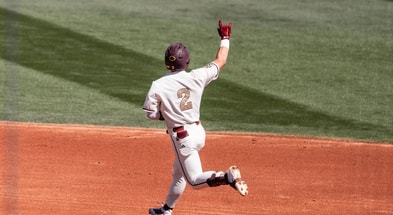
In another jaw-dropping night, sophomore outfielder Landon Hairston homered twice and added three RBIs, marking his 16th and 17th home runs of the season in just 29 games and his 14th in the last 16, helping ASU (21-8) to a 6-2 win over San Diego State.
In his last 50 at-bats, Hairston is 28-for-50 with eight walks, four doubles, and 11 home runs, against just three strikeouts. Each at-bat has turned into something that feels less like a matchup and more like an expectation.
According to head coach Willie Bloomquist, it is unlike anything he has witnessed.
“I don’t think people realize what he’s doing right now,” Bloomquist said. “You don’t see this in baseball very often. It’s incredible, it really is. And people go through stretches of four or five games of being in a zone, but again, not that I’ve been around this game forever, but I’ve never personally seen something like this.”
For Ellison, that level of dominance is not theoretical. He lived alongside it. For four seasons, he shared the outfield with Bonds, absorbing the routines, discipline, and presence of one of the greatest hitters the game has ever seen.
Ellison once reflected on that time in 2006 simply. “He’s been really good to me. He’s taught me a lot.” He was 25 when he joined the Giants. Bonds was 38 in their first season together.
Their connection went beyond proximity. In Bonds’ final years, Ellison often stepped in as a defensive replacement and pinch-runner when age limited Bonds’ range and speed.
“I don’t really see myself as a caddie,” Ellison said in the Kitsap Sun. “I know I can play, but the guy I’m playing behind is not bad.”
He never embraced the label, but the connection was clear. He watched Bonds’ greatness up close, learning from his work ethic and witnessing the standard firsthand.
That context helps explain why what he has seen recently stands out. After ASU’s 6-2 win over SDSU, Ellison told Bloomquist, “I haven’t seen anything like this, other than Bonds. This is on that level.”
That is more than high praise. Ellison witnessed a period in which Bonds hit 121 home runs, walked 504 times in a season, including 232 intentionally, and struck out just 156 times in 2004. The first two years Ellison played with Bonds were the seasons Bonds won his third and fourth consecutive MVP awards.
College and professional baseball operate on different planes, but Hairston’s production at 20 years old is enough to leave both Bloomquist, a 14-year big leaguer, and Ellison, a six-year veteran, searching for context.
There are reasons for this. Bonds’ dominance was built on discipline. He was patient, rarely struck out, and could handle nearly any pitch. Teams often refused to challenge him, and when they did, he punished mistakes. Bonds holds the MLB records for total walks (2,558), intentional walks (688), and, of course, 762 home runs.
That same discipline is now defining Hairston’s surge. He entered Phoenix already polished, walking 12 more times than he struck out as a freshman while hitting .333 in the two-hole. An offseason of strength training and subtle swing adjustments added more backspin to his contact.
That reduced his ground-ball rate by 15.6 percent and increased his fly-ball rate by 16.1 percent. With more power, those fly balls now carry far beyond last season, when he hit just four home runs.
“I’m just trying to stay within myself,” Hairston said. “I’m not trying to play into their game. I did that a lot last year when teams started to figure out my weaknesses. I was trying to swing at what they wanted me to swing at. So I’m trying to focus on what I want and stick to that.”
He has stayed true to that approach. Through 29 games, he has struck out only 12 times while walking 18. He is selective at the plate and rarely chases marginal pitches. When he does miss, he adjusts quickly. A hittable ball over the plate becomes a missile to the fences.
Even during Monday’s contest, comparisons to Bonds were hard to escape. During the ASU ESPN+ broadcast in the seventh inning, after he had already homered in the fifth, Hairston’s at-bats per home run were compared to Bonds’s historic 2001 campaign. Bonds set the MLB record with 73 home runs that season, averaging 6.52 at-bats per home run, while Hairston’s pace stood at 7.00.
The next pitch proved to be much more than just a comparison. Hairston reached for the 1-1 breaking ball and sent it 420 feet to right field for his second home run of the night.
The accolades continue to pour in for Hairston. He was named Golden Spikes Player of the Week after hitting five home runs, including four against No. 13 West Virginia, whose pitching staff entered the series with the Big 12’s best ERA at 3.28. Hairston homered four times in the series, including a grand slam to tie the ASU single-season record.
Pitchers have adjusted, but it has not mattered. Against SDSU, he saw multiple 3-0 counts before being challenged. West Virginia also intentionally walked Hairston twice over the weekend and issued a four-pitch walk with the bases loaded. Teams are still searching for answers.
“They’re throwing him just off the plate, and he’s not offering at that stuff. He’s not biting,” Bloomquist said. “I kind of half-jokingly said to Gaffy, I think maybe the way you pitch him is just get 3-0 so he has to take a strike, and then try to hope he gets too big on 3-1. But that doesn’t seem to work either.”
Direct Bonds comparisons will always feel far-fetched. Even grouping the two can feel like a stretch, but that reaction says more about Hairston’s surge than anything else. The mix of patience, power, and precision is driving this run, and pitchers adjust, change plans, and still come up empty. At 20 years old, Hairston is building something rare.
That belief has only grown stronger for Bloomquist, who said postgame he sees Hairston as the best player in the sport.
“I haven’t seen somebody better,” Bloomquist said. “There are some great players out there. I definitely have not seen a better hitter than him. He’s just in one of those zones that you can’t teach. There’s nothing you can do to get somebody to ever get like that. It’s just natural ability and just happens. And when you’re in a zone, you’re in a zone.”