“Catching my stride”: Randy Bennett details health scare, credits ASU staff for early progress in return to coaching


For nearly six weeks, Arizona State’s new men’s basketball coach was both the most important person in the program’s future and someone the public rarely saw.
Randy Bennett was hired March 23 to replace Bobby Hurley after 11 seasons, a move that immediately signaled a philosophical shift for Sun Devil basketball. But when ASU planned to formally introduce him, the moment never came. Athletic director Graham Rossini later described Bennett as “feeling under the weather, dealing with an illness,” and the introductory press conference was postponed.
Shortly after, Bennett issued a statement that framed the situation in cautious but reassuring terms.
“Last week, when I arrived in Arizona, a health situation surfaced that I’m working through right now,” Bennett said. “I’m in good hands, we feel good about the plan, and I’m incredibly appreciative of the care I’ve received from the team at Mayo Clinic. Everything is under control, and I will be back at full strength very soon.”
That public update was the only clarity offered at the time. What followed was a stretch of silence, recovery and behind-the-scenes program building, while ASU’s newest coach worked through what he later described as a physically draining period that included a hospital stay and a gradual return to full strength.
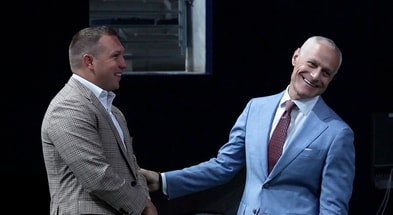
On Wednesday, Bennett finally appeared in front of reporters for his introductory press conference, and he did not avoid the subject that had defined the early part of his tenure.
“First of all, sorry about the pump fake on the first one. I should do much better on this one,” Bennett said. “So anyhow, actually, it’s kind of good because I know a lot more about the program now. I had five weeks here.”
The humor landed lightly, but the context behind it was unmistakable. Bennett’s first weeks in Tempe were not the typical whirlwind of press appearances, roster evaluations and recruiting pitches. Instead, they were shaped by recovery and limited availability as he navigated a health scare that temporarily pulled him away from day-to-day operations.
“Was really weak in the hospital for 10 days,” Bennett said. “So you get weak and so there’s a little comeback and competence, but I knew we were good… (It was) hard, you just got this job, you want to get going, and wanted to start building, like you feel like since there’s urgency, you need to be in the office but this wasn’t going to happen. It’s tough.”
Even in that early adjustment period, Bennett said he began to understand what makes ASU different from the program he led for 25 years at Saint Mary’s College of California, where he built one of the most consistent mid-major programs in the country.
“Where I was at was a small school, different deal, not part of the powerful,” Bennett said. “And yeah, I have no regrets. I love where I was at St. Mary’s. But this place is different. This place has some juice.”
That “juice,” as Bennett described it, came with expectations and urgency, but also with a structure that he leaned on heavily while he was not at full strength.
One of the clearest themes of his press conference was the importance of the staff assembled around him, a group he repeatedly credited for stabilizing the program during his absence and early recovery period.
“These three jumped in,” Bennett said. “And I had to go back and get EJ from St. Mary’s. He was a really good point guard for us at St. Mary’s. Next year will be his third year in coaching.”
He was referring to EJ Rowland, a former Saint Mary’s guard who played professionally overseas for two decades before entering coaching. Rowland is now part of Bennett’s ASU staff, continuing a long relationship that stretches back to Bennett’s early NCAA Tournament teams.
Bennett also highlighted assistants Joe Rahon and David Patrick, as well as Rick Croy, who arrived after a highly successful run at California Baptist, where he built the program into a Western Athletic Conference champion and NCAA Tournament team.
“First of all, they carried me for the first two weeks of this job,” Bennett said. “And Rick and David and Joe were here right away. And we didn’t have a team, so it was interesting. We had to go build a team.”
That staff construction was not accidental. ASU’s leadership, including Rossini, prioritized experience and versatility in hiring a group that includes former head coaches, elite recruiters and program builders with deep regional and international ties.
Bennett made it clear that structure mattered more than ever during his early weeks, especially given the demands of modern roster management.
“I think the biggest thing in coaching, I tell people this, is the most important thing is your staff, the people you surround yourself with,” he said. “Your staff will get you good players, and they’ll lead those guys to be right and to get better, and eventually for those guys to become leaders.”
That belief was tested almost immediately, as Bennett’s limited availability during recovery forced assistants to take on expanded roles in recruiting, roster assembly and portal communication. At the same time, ASU was building toward a new roster in a rapidly changing NIL and transfer portal landscape.
By the time Bennett was fully re-engaged, the structure around him was already taking shape.
“Taking better care of myself. Maybe not,” Bennett said. “Hired a great staff, so I think they’ll cover for me. And they’re fully capable. A lot of them have been head coaches. They’ll all be head coaches again if they haven’t already been. So I have a lot of trust there. We’re resourced.”
The medical issue itself has never been publicly disclosed beyond Bennett’s initial statement and his reference to treatment at Mayo Clinic. No diagnosis has been released, and Bennett has not suggested any long-term limitation. What he has made clear is that the situation was serious enough to delay his introduction and briefly limit his early involvement.
Still, by the time he reached the podium Wednesday, Bennett described himself as fully back in the rhythm of the job, with a roster assembled, staff in place and a schedule taking shape.
Now, the focus shifts from recovery and introduction to implementation.
At Saint Mary’s, Bennett became known for defensive identity, international recruiting pipelines and sustained success in the West Coast Conference, including 12 NCAA Tournament appearances and a 2010 Sweet 16 run that helped elevate the program nationally.
At ASU, the challenge is different, but Bennett believes the foundation is already forming, even if his start was delayed.
“Now I’m catching my stride,” Bennett said. “Able to work long days. Longer days. We’ve gotten a lot done in five weeks. So I feel good now.”